

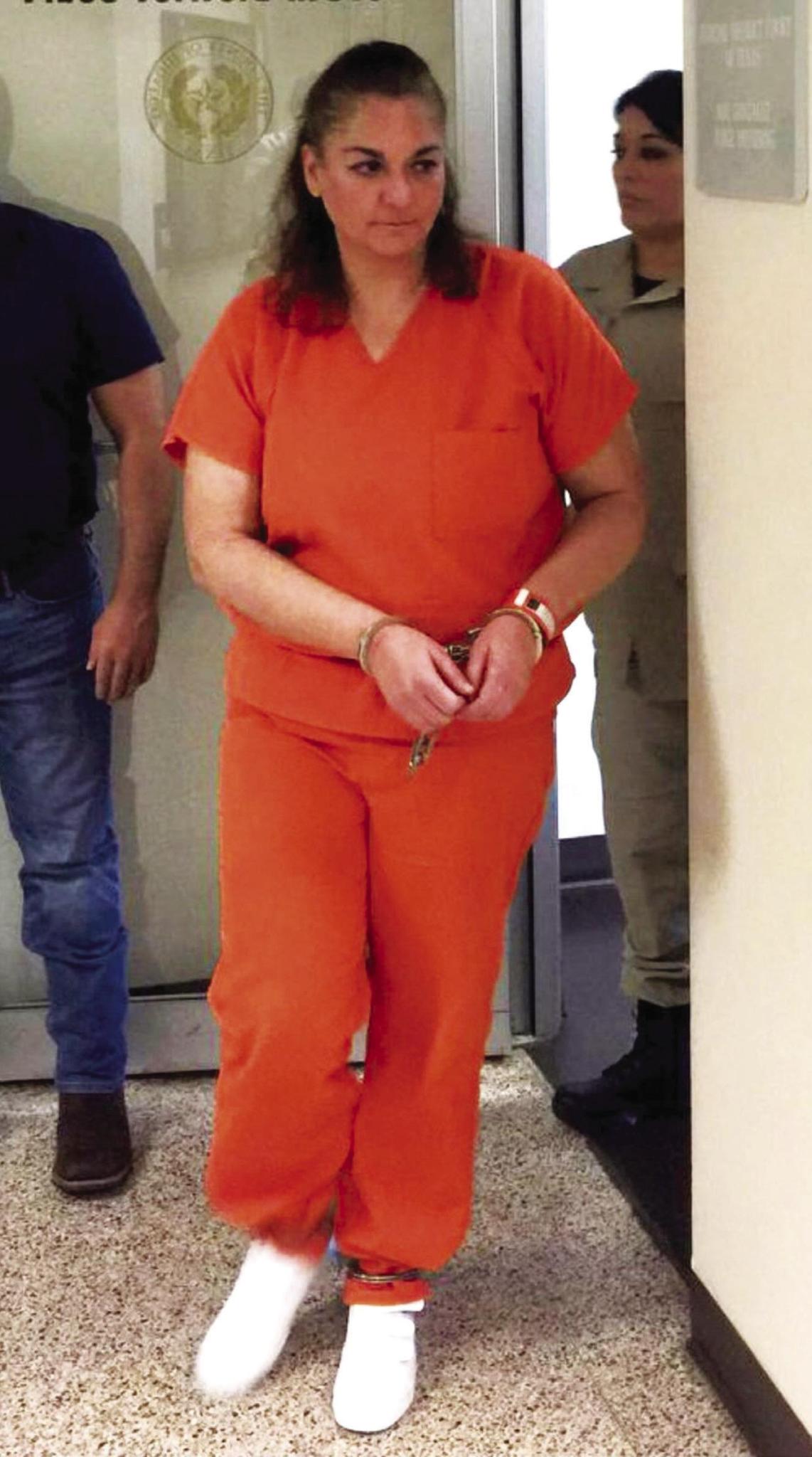


Probate trial delayed: Murder victim’s estate still in hands of his killer
If you put yourself in the place of Mark Knell and family, it’s not a good place to be.
Approximately 11 years after his 96-year-old dad was murdered, smothered to death, at his home in north McAllen in late January 2015, the convicted killer still controls the estate, valued in excess of $1 million.
In November 2017, Monica Melissa Palacios Patterson was convicted in state District Court (the 370th) of murdering 96-year-old McAllen WWII veteran Martin Knell just to keep her name on his Will, control of his estate, including all his assets.
The Murder Plot
Approximately a day before Knell's murder, Jan. 28, 2015, the old vet discovered that Patterson had placed her name on his stock certificates as the payee-on- death. Without, oops, bothering to tell him.
Upset to be tied, he told her, in front of at least one witness, that he wanted back the power of attorney he had recently handed her. Plus, he was going to remove her name from his Will. After all, he had a son more deserving.
During the months leading up to his murder, Patterson had convinced "Marty" Knell that his son couldn't be trusted to look out in his best interests. Rather, she was the one who could best handle his financial affairs. And so, the two drove to visit the office of a local attorney (Patterson chose the attorney) where Knell's Will was changed, naming Patterson as its beneficiary, even though the two had known each other for barely three months. That would include the first month when Patterson called the McAllen police on Knell for causing a scene at the hospice facility .
Then, Patterson learned how much he was worth, well in excess of $1 million, and the whole dynamic changed abruptly.
"Marty, why don't you come out to my house for a nice home-cooked meal?"
After the legal business was over, the old Will changed to the new, the two, arm in arm, went to "Marty" Knell's branch bank in McAllen and withdrew approximately $150,000. In cash.
At the time, the late fall of 2014, Melissa Patterson was still working as the chief administrator at The Comfort House (a McAllen hospice) where Knell's wife, Penny, had been admitted in late September. Her days were indeed numbered. She knew it, and her son and family knew it. But on Oct. 22, according to her son, Mark Knell, she still had light in her eyes, and was firmly opposed to the changing of the Will, handing everything over to Patterson.
However, it just so happened that the day after "Marty" Knell's last living will and testament was changed at the local law office, and the $150K withdrawn from the bank, Oct. 22, Penny Knell was unexpectedly pronounced dead at the hospice, the Comfort House, the very next day, Oct. 23.
Fast forward approximately three months, and "Marty" Knell discovered Patterson's deceipt with regard to his stock certificates. He calls her out on it, says he wants back his power of attorney, is going to change his Will, and within a day or two, he is dead, too, slumped over his kitchen table.
Cardiac arrest, the old vet is past the age of 95, nothing unusual about that perhaps.
Except for this one simple, undeniable fact -- while EMS paramedics were still administering life-saving measures on Knell, at his McAllen home off Ware Rd., not knowing he had already been dead past the point of no return, Patterson raced to the scene from The Comfort House, in her own car, with medical power of attorney in hand, demanding that EMS stop trying to revive "Marty."
In her clutched hand, Patterson also had the "Do Not Resuscitate" order, notarized, that Knell had previously signed, worried that he might one day end up in a hospital, hooked up to a machine. If he had a heart attack under those conditions, no, he didn't want to be revived.
But during efforts to try and revive someone without a pulse, hoping to restore life, no, the paramedics had never run into anyone showing up at the scene to present a "Do Not Resuscitate" order. In those situations, friends, family, are usually hoping for revival, survival.
To murder Knell, Patterson used a male accomplice who did odd jobs around the hospice. She promised him money from the Knell estate, according to his own signed confession, but was never paid, he told investigators.
The accomplice told investigators that both he and Patterson had visited the Knell home the morning of Jan. 28, 2015, asphyxiated him while one of them held him down in his kitchen chair, and the other placed a plastic bag over his head.
Once fit and solid like a rock, a former McAllen mailman and a little league coach, Knell was still exercising at the time of his death, and was in pretty good shape for a man of 96, but he had no chance against someone of Patterson’s stout build, not to mention a set of male arms helping her commit what she thought would be the perfect murder. For a woman who had failed at past business ventures, grabbing Knell's wealthy estate should have proven relatively full proof. Or so she thought.
Sure, there was an eyewitness to the murder, Mr. Knell’s part-time caretaker, but Patterson, along with her male accomplice, must have thought the two of them had scared the woman well enough for her to never breathe a word of what she saw, according to first-hand court testimony handed down during Patterson's murder trial (late fall of 2017).
"You mention this to anyone and you're dead."
But in the end, despite fearing for her life, the caretaker, standing maybe 4', 11, went to the Texas Rangers field office in Weslaco and told the tale of the death of “Marty” Knell.
At the time, he was already dead and buried. His death marked down as “cardiac arrest.”
No one knew a capital murder had taken place.
Until, that is, the caretaker said she just could no longer keep quiet about what she knew. Her conscience was getting the best of her. Plus, she was in fear of her life, moving from the home of one relative to the next to sleep, never staying in one place too long.
After the caretaker spilled the beans, a long criminal investigative process began, in collaboration with both the Texas Rangers and the Hidalgo County SO, leading to Melissa Patterson’s arrest in August of 2015, approximately seven months after the murder.
It was only after her arrest that the Comfort House's board of directors, which included a former chief justice of the 13th Court of Criminal Appeals, learned that Patterson had completely wiped out their bank accounts, including their investment account. Plus, without board knowledge or approval, she had forged board minutes so she could open a secret bank account under the Comfort House name, through which she could filter undetected stolen money for personal gain.
The Probate Snag
Last week, the victim’s son, Mark Knell, learned that once again, the probate trial has been delayed in this county's probate court.
Six months. Standard deal. It’s almost as if every six months, the Hidalgo County probate script just resets to another six months down the road.
It’s always “something.”
A new lawyer, a new this, a new that.
"We need more time, judge."
Granted.
No matter that the murder victim has now been buried in the ground for more than 11 years, and his killer still has her name attached to his Last Will and Testament after she was convicted of his brutal murder in early November 2017. What’s another six months?
The probate trial is now set for October 2026.
Who’s to say it won’t get kicked down the road again come October?
No one knows. The assets that once belonged to her murder victim are tied up by the probate court, so no one can get to the money and stock certificates. But still, the fact that the family of her murder victim still can’t get what is rightfully theirs, more than 11 years after the murder, has to be some kind of record.
Interestingly enough, “Missy” Patterson presumably had more "stolen money" at one time, because in May of 2018, approximately six months after her murder conviction, she had a family member to whom she had assigned power of attorney visit the IRS to pay off four tax liens worth a total of $561,025.26. Whether all of that was Knell's money or some of it was the money she stole from the Comfort House, no one could possibly know.
Plus, she must have had to pay something in legal fees, considering that she had four of the very top criminal defense attorneys in this county who tried, but failed, to free her from the murder rap. Given her family ties and political swag (dad is a former Hidalgo County commissioner; her brother is a current county-court-at- law judge), the attorneys probably didn’t charge her their full fee. But since the trial took almost six weeks, after a two-year lead up to jury selection, pre-trial hearings, etc., all the time a capital murder trial takes to defend, it’s doubtful they all worked for free.
Quick Move to Probate?
Last but not least, no one can say that Melissa Patterson, now 58, can’t move fast when she wants to.
She murdered "Marty" Knell Jan. 28, 2015.
Nineteen days later, Feb. 16, 2015, she was already at the Hidalgo County Courthouse, filing papers to probate her murder victim’s estate, which still listed her as the main beneficiary.
There at the bottom of the probate court filing reads:
“Decedent left a valid Will date December 22, 2014, which was never revoked.”
As admitted into evidence during Melissa Patterson’s murder trial in October 2017, the only reason “Marty” Knell’s Will was never revoked was because she killed him before he had a chance to change it, a day or so after telling her, in front of at least one witness, that’s what he planned to do after discovering she was a fraud and a shyster.
Patterson was rightly convicted. The evidence against her is overwhelming as laid out in two cable shows — Discover ID’s Diabolical and Oxygen’s Snapped. One of which can usually be found on YouTube.